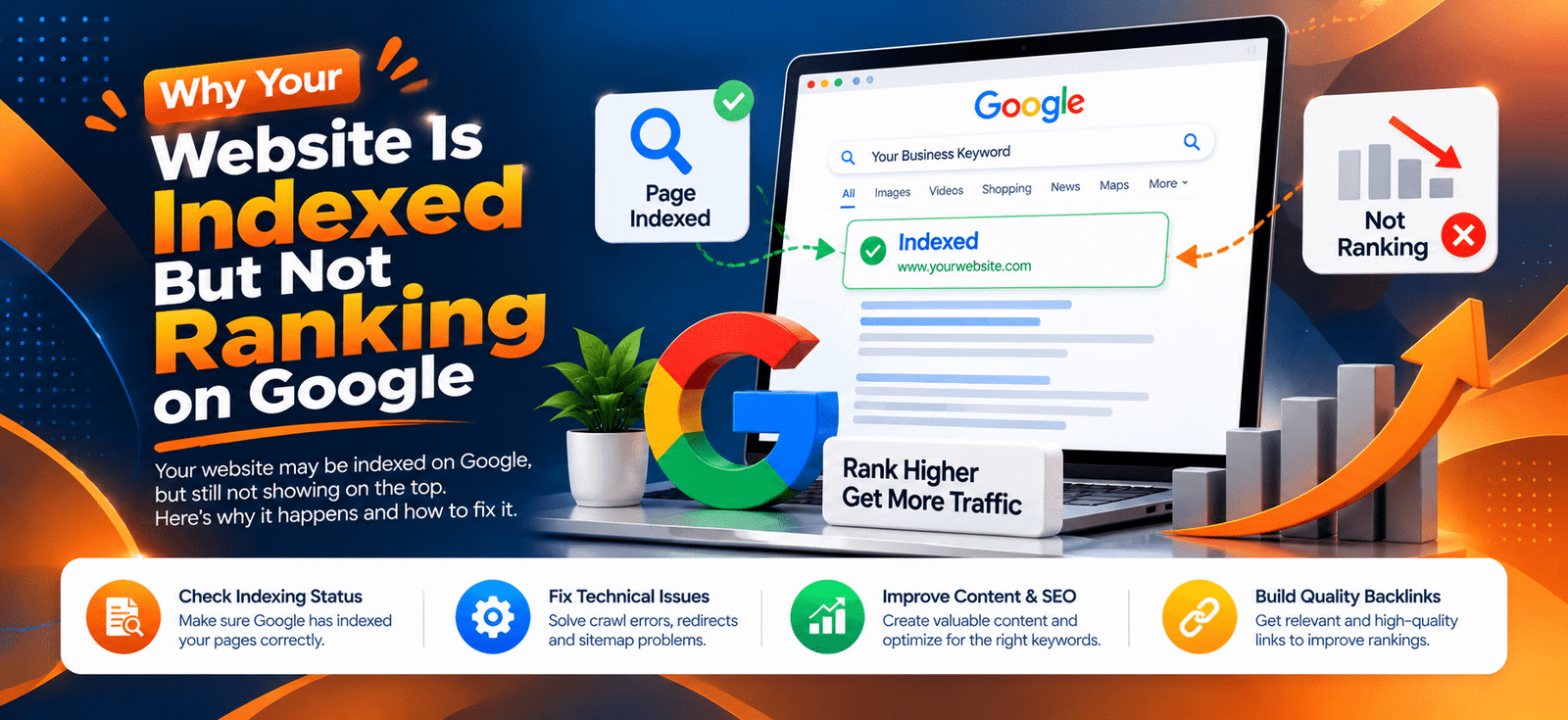
Why Your Website Is Indexed But Not Ranking on Google
Getting a website indexed by Google can feel like a major step forward, but indexing alone does not mean your website will automatically appear on the first page of search results. Many business owners check Google Search Console, see that their page is indexed, and then wonder why they still cannot find it for their target keywords.
If your Website Indexed But Not Ranking on Google, it does not necessarily mean something is technically wrong with the website. Google may know that your page exists, but it still needs to determine how relevant, useful, trustworthy, and competitive that page is compared with other pages targeting the same search.
At Web Intro, we look beyond indexing status to understand why a website is not gaining meaningful search visibility. Content quality, search intent, competition, internal linking, website structure, authority, technical SEO, and overall site quality can all influence organic performance.
This guide explains the major reasons an indexed website may not rank and what businesses can do to build stronger Google visibility.
Get A Free Consultation !
Why Is My Website Indexed But Not Ranking on Google?
There is rarely one universal reason. In many cases, several smaller SEO issues work together.
1. Your Page Does Not Fully Match Search Intent
One of the first things to evaluate is search intent.
Suppose someone searches for a commercial service. Google will generally try to provide results that satisfy what users making that search are likely trying to accomplish.
If your page targets the keyword but its actual content does not adequately address the user’s needs, repeating the keyword more often is unlikely to solve the problem.
A strong page should clearly answer questions such as: What does the business provide? Who is the service intended for? Why should a customer consider it? What useful information does the visitor need before contacting the company?
SEO should begin with the user behind the search, not simply the keyword.
2. The Target Keyword Is Highly Competitive
A newly published page may be technically excellent and still struggle for a highly competitive keyword.
Established competitors may already have strong websites, comprehensive content, relevant links, recognizable brands, local prominence, and years of search history.
That does not mean a newer page cannot compete. It means expectations should be realistic.
Instead of measuring success only by whether a page immediately reaches page one, businesses should also monitor whether Google impressions are increasing, relevant queries are appearing in Search Console, average positions are improving, and organic clicks are beginning to grow.
SEO progress can happen gradually.
3. Your Content Is Too Similar to Other Pages
This is particularly important for businesses creating location-based landing pages.
Creating separate pages for different locations can make sense when those pages genuinely serve different audiences. Problems can arise when dozens or hundreds of pages contain essentially the same content with only the city name changed.
For example, changing:
to:
“SEO services in Mumbai”
while leaving almost everything else identical does not automatically create a valuable new page.
Each important location page should have a genuine reason to exist. Its content should reflect the market, audience, services, local context, customer requirements, and useful information relevant to that location.
The objective should be unique value, not simply a unique URL.
4. Keyword Stuffing Can Make Content Less Useful
There was a time when some websites tried to improve relevance by repeating exact keywords throughout headings and paragraphs.
Modern SEO requires a much more natural approach.
If the same phrase appears unnecessarily in every heading, service description, FAQ, and paragraph, the page can become repetitive and unpleasant to read.
Instead of writing:
Best SEO Services in Mumbai provides the best SEO Services in Mumbai for businesses looking for SEO Services in Mumbai.
Write naturally:
Our SEO strategy helps Mumbai businesses improve their organic visibility by focusing on technical improvements, useful content, search intent, and relevant opportunities.
The topic remains clear without forcing the same phrase repeatedly.
A Website Indexed But Not Ranking on Google needs diagnosis, not automatic keyword repetition.
5. Your Website May Have Weak Internal Linking
Internal links help users and search engines discover related content across your website.
An important service or location page that has few meaningful internal links can effectively sit in isolation.
Relevant pages can link naturally to each other. For example, a digital marketing service page might link to an SEO service, a relevant location page, a useful guide, or a case study where those resources genuinely help the visitor.
The anchor text should describe the destination naturally rather than being stuffed with commercial keywords.
A logical internal linking structure also helps communicate which pages are most important within the website.
6. Your Website May Have Technical SEO Problems
Good content cannot compensate for every technical problem.
Technical issues can affect how efficiently search engines crawl, understand, and process a website.
Important areas to review include:
Indexability: Important pages should not accidentally contain noindex directives.
Robots.txt: Make sure important sections are not unintentionally blocked from crawling.
Canonical Tags: Important pages should point to the appropriate canonical URL.
HTTP Status Codes: Pages intended to rank should normally return the correct successful response rather than unnecessary redirects or errors.
XML Sitemap: Keep important indexable URLs in the sitemap and remove deleted or irrelevant URLs.
Mobile Usability: Pages should work properly across mobile devices.
Site Performance: Slow or unstable experiences can negatively affect users.
Technical SEO is therefore an important part of investigating why a Website Indexed But Not Ranking on Google.
7. The Page Is New and Needs Time
A common SEO mistake is judging a new page too quickly.
A page can become indexed relatively fast without immediately receiving strong rankings.
Google still needs to understand the page, evaluate it in the context of the broader website, compare it with competing results, and collect additional signals over time.
For this reason, changing the title, URL, headings, and content every few days can make it harder to evaluate what is actually happening.
Once a strong page is published and technically sound, monitor its performance before making unnecessary changes.
How to Improve Rankings for an Indexed Website
If your website is indexed but not receiving meaningful rankings, avoid making random changes.
Start by reviewing the page’s target search intent and competing results. Check whether the content genuinely satisfies the query and whether it offers useful information beyond basic marketing statements.
Next, review technical SEO, internal linking, site structure, content quality, mobile experience, and relevant authority signals.
Use Google Search Console to understand which queries already generate impressions. A page receiving impressions around relevant searches is providing useful information about how Google currently understands it.
From there, improvements can be based on evidence rather than guesswork.
Frequently Asked Questions
Why is my website indexed but not showing on Google?
An indexed page may not appear prominently for your target search because of competition, search intent, content quality, website authority, internal linking, technical factors, or other relevance signals. Indexing alone does not guarantee a high ranking.
Does indexing mean my website will rank?
No. Indexing means Google can include the page in its search index. Ranking determines where and when that page may appear for particular searches.
Should I repeat my focus keyword more often if the page isn’t ranking?
Not automatically. If the keyword already appears naturally in important areas, adding unnecessary repetitions can make the content worse. First investigate search intent, competition, page quality, internal linking, and technical SEO.
How long does a newly indexed page take to rank?
There is no fixed ranking timeline. It depends on factors including competition, website history, page quality, search intent, technical condition, and Google’s processing of the page.
Should I request indexing repeatedly?
Once an accessible page has been discovered and indexed, repeatedly requesting indexing is not a substitute for improving its quality or relevance.
Can Web Intro help improve organic search visibility?
Yes. Web Intro provides SEO and digital marketing solutions focused on technical optimization, content, search intent, local visibility, website improvements, and sustainable organic growth.